Mission briefing
Technical Dossier
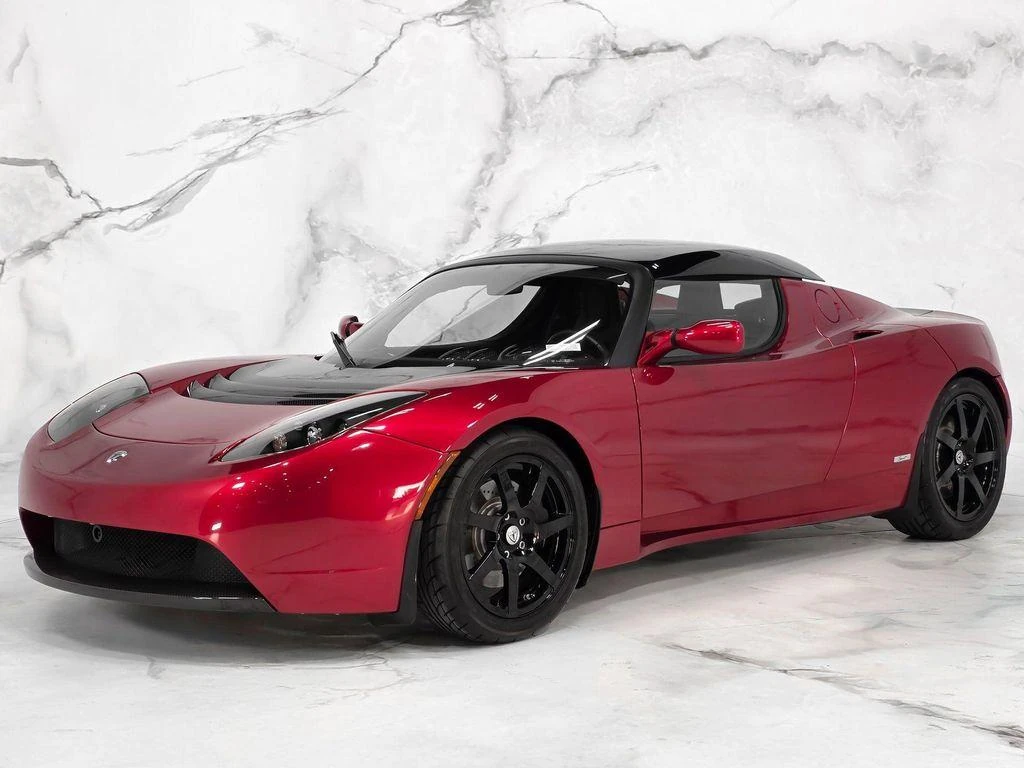
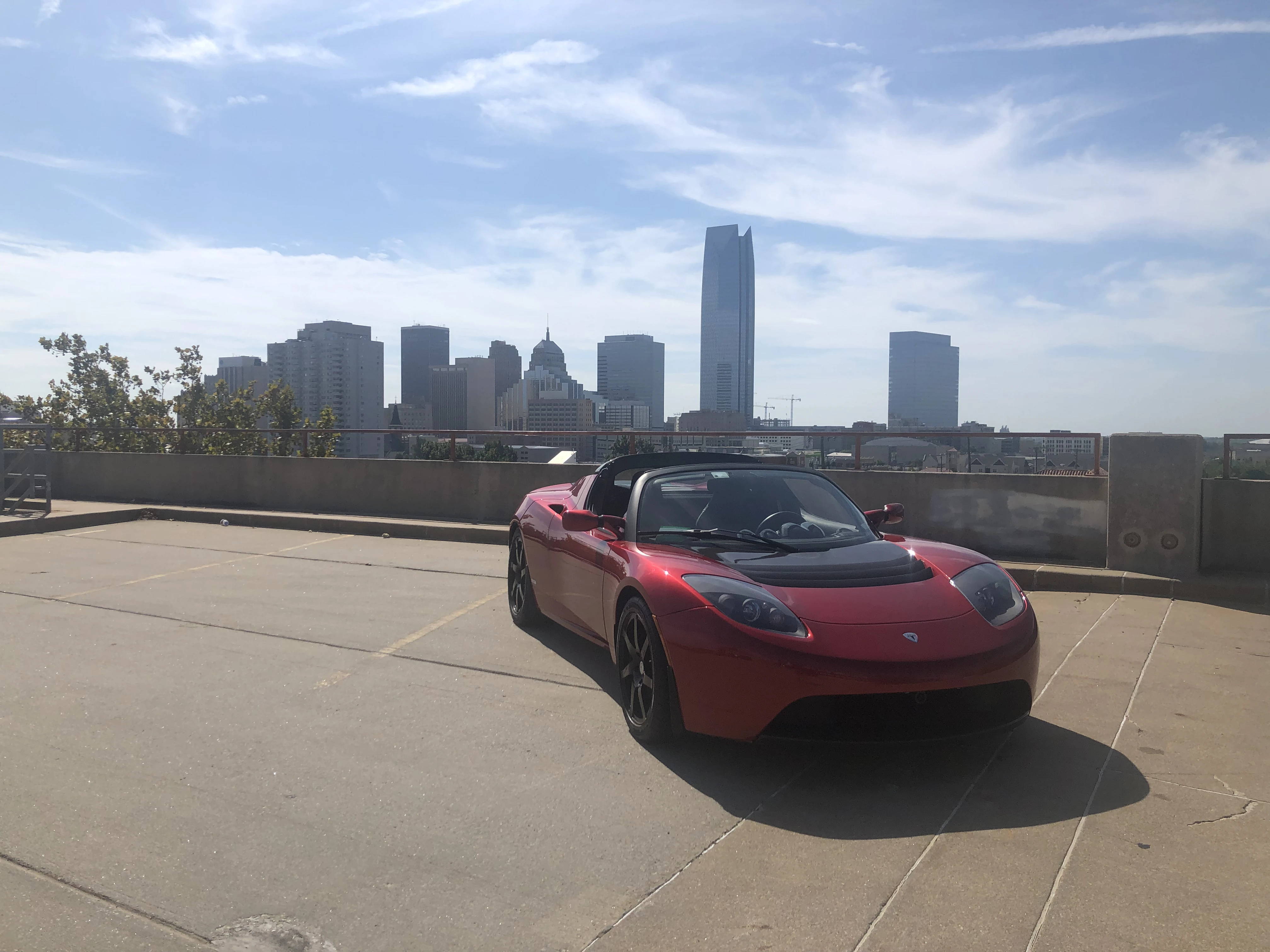
A technical brief on the original Tesla Roadster (2008–2012), with emphasis on the Roadster Sport and Roadster 2.5. The figures below describe the model in general. They are taken from official and archival sources, cited at the end of this section.
Flight Data
Cells
6,831
Li-ion cells in the Energy Storage System24
Cell format
18650
18 mm × 65 mm commodity cells3
Usable energy
53 kWh
As stated in Tesla’s 2011 Form S-17
Pack mass
~900 lb
408 kg, Tesla service data24
Sport peak power
288 hp
215 kW, 2010 Tesla specifications1
Sport peak torque
295 lb-ft
400 Nm, 2010 Tesla specifications1
Sport 0–60 mph
3.7 s
Base Roadster: 3.9 s17
Top speed
125 mph
Electronically limited, 2010 specifications1
EPA combined range
245 mi “400+ mi” after R80, Tesla est.
Two-cycle city/highway test, 2011 S-117
Curb weight
2,723 lb
1,235 kg, no occupants or cargo45
Energy Storage System
Tesla described the pack as an Energy Storage System of 6,831 individual lithium-ion cells, “roughly the size of a storage trunk,” and “about 900 pounds.”2 Tesla’s service data lists the same cell count and a pack weight of “~900 lb (408 kg).”4 The company’s battery paper says the pack was designed around commodity 18650 cells — so named for an 18 mm diameter and 65 mm length — and “stores about 53 kilowatt hours of electric energy.”3 Tesla’s 2011 Form S-1 states that the pack “contains 53 kilowatt-hours of usable energy” and “uses commercially available lithium-ion battery cells.”7
Tesla’s official service documentation describes the internal layout as 11 sheets in series, each sheet made of 9 bricks in series, and each brick a group of 69 cells in parallel (11 × 9 × 69 = 6,831).6 Official public materials consistently call the chemistry lithium-ion; they do not name a single cell supplier or a more specific cathode chemistry, so those details are omitted here.
Powertrain and gearbox
Tesla’s service data lists the motor as a 3-phase, 4-pole electric motor, rated at 375 V, with a maximum speed of 14,000 rpm.4 The company’s 2010 performance specifications describe a “375 volt AC induction air-cooled electric motor with variable frequency drive.” For the Roadster Sport they list “288 peak horsepower (215kW) and 295 lb-ft (400 Nm) of torque,” “0 to 60 mph in 3.7 seconds,” and a top speed of “125 mph (electronically limited).” The same page lists the base Roadster at the same peak horsepower, 273 lb-ft (370 Nm), and 3.9 seconds to 60 mph.1
Early production used a two-speed transmission. On September 9, 2008, Tesla announced it had “selected BorgWarner Inc. for the production of a single-speed gearbox for the Tesla Roadster.” CTO JB Straubel said that the previous December, “when the two-speed transmission designed by a previous supplier proved not to be durable, we announced we would modify our approach,” and that a more powerful inverter and enhanced motor allowed a single-speed gearbox while still meeting the original performance goals.8 That announcement also said the new powertrain “achieves an EPA combined range of 244 miles on a single charge, up from Tesla’s previously announced EPA range of 221 miles.” Tesla’s later 2010 specifications and 2011 S-1 state a range of 245 miles on the EPA combined two-cycle test.17
Chassis and assembly
In a March 2008 company blog, Tesla wrote that the Roadster is not “an electrified Lotus Elise,” and that “the total number [of shared parts] was under 7% by parts count.” The same post says “body panels (except for the bumpers) are made entirely of carbon fiber to minimize weight.”9
Assembly was split. A July 2008 Tesla blog described Lotus assembling the car at Hethel, in the United Kingdom, as a “glider,” with “everything but the battery and powertrain” installed there, then shipped to California. “The Tesla Store about to open in Menlo Park will do the final installation of the battery and powertrain.” The same account states that 6,831 lithium-ion cells were sent from Japan to California, where the battery was built.10 Tesla’s published curb weight for the Roadster 2 / Roadster Sport is 2,723 lb (1,235 kg), with no occupants or cargo.45
Range, firsts, and a long-distance run
Tesla’s October 27, 2009 press release states: “The Tesla Roadster is the first production automobile to use lithium-ion battery cells and the first production EV with a range greater than 200 miles (320 km) per charge.”14 The same release reports that a Roadster completed 313 miles (501 km) on a single charge in Australia’s Global Green Challenge, a conservation run rather than an EPA test. For the later Roadster 3.0 upgrade package, Tesla estimated “a predicted 40-50% improvement on range” and wrote that, under “a set of speeds and driving conditions,” it could “confidently drive the Roadster 3.0 over 400 miles.” That estimate is not an EPA rating.16
- 200 mi — firsts-claim threshold
- 245 mi — EPA combined, 2011 S-1
- 313 mi — 2009 challenge run
- 400+ mi — Tesla estimate, Roadster 3.0
Not the same test. The solid bar marks the EPA combined rating. The dashed bar is Tesla’s stated Roadster 3.0 estimate, not an EPA figure.
Versions and the Roadster 3.0 upgrade
Tesla’s service data distinguishes a Roadster 1.5 motor (215 kW, 370 Nm) from a Roadster 2.x motor (215 kW, 400 Nm), both 3-phase, 4-pole units.4 The 2008 single-speed BorgWarner powertrain is the official account of the 1.5-era drivetrain change.8 Tesla’s 2011 S-1 says the company introduced “the Tesla Roadster 2, and its higher performance option package Roadster Sport,” and that “On July 1, 2010, we introduced the Roadster 2.5, with new styling and an upgraded interior.”7 The July 1, 2010 announcement lists a new front fascia and rear diffuser, new seats, power-control hardware for very hot climates, an optional 7-inch touchscreen with back-up camera, and added interior sound reduction.13
On December 26, 2014, Tesla announced a prototype “Roadster 3.0 package,” including a pack that “delivers roughly 70kWh in the same package as the original battery,” plus planned aerodynamic and tire changes.16 In that post Tesla estimated “a predicted 40-50% improvement on range between the original Roadster and Roadster 3.0,” and wrote: “There is a set of speeds and driving conditions where we can confidently drive the Roadster 3.0 over 400 miles.” That is Tesla’s stated estimate for the Roadster 3.0 upgrade package. It is not an EPA rating.16 In July 2016, Electrek reported that the production retrofit, referred to as R80 for its roughly 80 kWh capacity, had begun to reach owners, and that the retrofitted packs “are rated at about 340 miles of range.”17 No equivalently solid official source was found for a later “R90” pack, so none is listed here.
Mission Record
-
July 19, 2006
Tesla unveils the Roadster at Barker Hangar, Santa Monica Airport.11
-
March 17, 2008
Tesla announces that regular production of the Roadster has begun.12
-
September 9, 2008
Tesla selects BorgWarner to produce a single-speed gearbox, after a prior two-speed design “proved not to be durable.”8
-
October 27, 2009
A Roadster completes 313 miles (501 km) on a single charge in the Global Green Challenge in Australia.14
-
January 20, 2010
Tesla enters a loan facility with the U.S. Department of Energy and the Federal Financing Bank, under the Advanced Technology Vehicles Manufacturing program, for up to $465.0 million — $101.2 million for a powertrain facility and $363.9 million for Model S development and manufacturing. The facility was not a Roadster production loan.7
-
July 1–2, 2010
Tesla introduces Roadster 2.5 on July 1. The company’s IPO closes on July 2. WIRED later wrote that this made Tesla “the first American car company to complete an initial public offering since Ford in 1956.”13718
-
January 2012 / December 31, 2012
Tesla’s 2012 Form 10-K states that it “concluded the production run of our current generation Tesla Roadster at 2,500 vehicles” in January 2012, and that as of December 31, 2012, it “had delivered approximately 2,450 Tesla Roadsters to customers in over 30 countries.”15
-
December 26, 2014
Tesla announces the prototype Roadster 3.0 package, including a higher-capacity battery.16
-
February 6, 2018
A Tesla Roadster flew as the payload on Falcon Heavy’s first flight.1920
Sources
- Tesla, 2010 Roadster performance specifications (Wayback Machine snapshot of teslamotors.com).
- Tesla, “A Bit About Batteries,” November 30, 2006 (Wayback Machine snapshot).
- Tesla, “The Tesla Roadster Battery System” (official technical paper, Wayback Machine snapshot).
- Tesla Roadster Service Manual, Technical Data (official service documentation, Wayback Machine snapshot).
- Tesla Roadster 2 Owner’s Manual (official PDF hosted by Tesla, Wayback Machine snapshot).
- Tesla Roadster service documentation, battery description and operation (official Tesla service site).
- Tesla Motors, Inc., Form S-1, filed May 25, 2011 (Wayback Machine snapshot of the SEC filing).
- Tesla press release, “Tesla Motors Selects BorgWarner for Production of New Gearbox,” September 9, 2008 (Wayback Machine snapshot).
- Tesla, “Mythbusters Part 2: The Tesla Roadster is not a Converted Lotus Elise,” March 3, 2008 (Wayback Machine snapshot).
- Tesla, “Flying the Glider,” July 18, 2008 (Wayback Machine snapshot of the company blog).
- Tesla, July 19, 2006 world debut press release (Wayback Machine snapshot).
- Tesla, “We have begun regular production of the Tesla Roadster,” March 17, 2008 (Wayback Machine snapshot).
- Tesla press release, “Tesla Unveils Roadster 2.5,” July 1, 2010 (Wayback Machine snapshot).
- Tesla press release, “Tesla Roadster Travels 313 Miles on a Single Charge,” October 27, 2009 (Wayback Machine snapshot).
- Tesla Motors, Inc., Form 10-K for the year ended December 31, 2012 (Wayback Machine snapshot of the SEC filing).
- Tesla, “Roadster 3.0,” December 26, 2014 (Wayback Machine snapshot).
- Electrek, “Tesla Roadster 3.0 battery upgrade (R80) are finally starting to arrive,” July 8, 2016.
- Joshua Davis, “How Elon Musk Turned Tesla Into the Car Company of the Future,” WIRED, September 27, 2010.
- SpaceX, Falcon Heavy Demonstration Mission (official mission page for the February 6, 2018 first flight).
- NASA, “5 Years Ago: First Flight of the Falcon Heavy Rocket”.
- Where is Roadster (Starman tracker).
Source links go to third-party sites, including official and archival Tesla and SpaceX pages, U.S. government filings, and independent publications. They are provided for historical reference and are not affiliated with this site or the owner. This is an independent fan page, not affiliated with, sponsored by, or endorsed by Tesla, Inc. or SpaceX.